
Acne Scars Treatment Singapore
What Causes Pimple Scars & How To Treat Them?
There are many different types of acne scars treatment available in the market, but how do you choose which treatment is suitable for you? Find out the different types of acne scars and the types of treatments available for your skin.
Pimple scars, acne scars, pock marks or acne marks are usually caused by inflamed lesions and enlarged pores that leave a break in the follicle wall. As the body attempts to heal itself by forming new collagen fibers to replace the lost tissue that has been destroyed, it doesn’t usually end up as smooth and flawless as before. As the wound heals, the body can sometimes produce either too much or too little collagen, creating raised tissue or an indentation on the skin’s surface.
Many patients are concerned if these pock marks can be removed. Unfortunately, most of them do not fade over time, but acne scars do go away when treated properly.
There are several treatments for those suffering from pimple scars or acne scars. Some acne scar treatments are more effective at getting rid of specific types of acne scars. Suitable treatment options may vary slightly depending on the type of scarring that acne has caused.
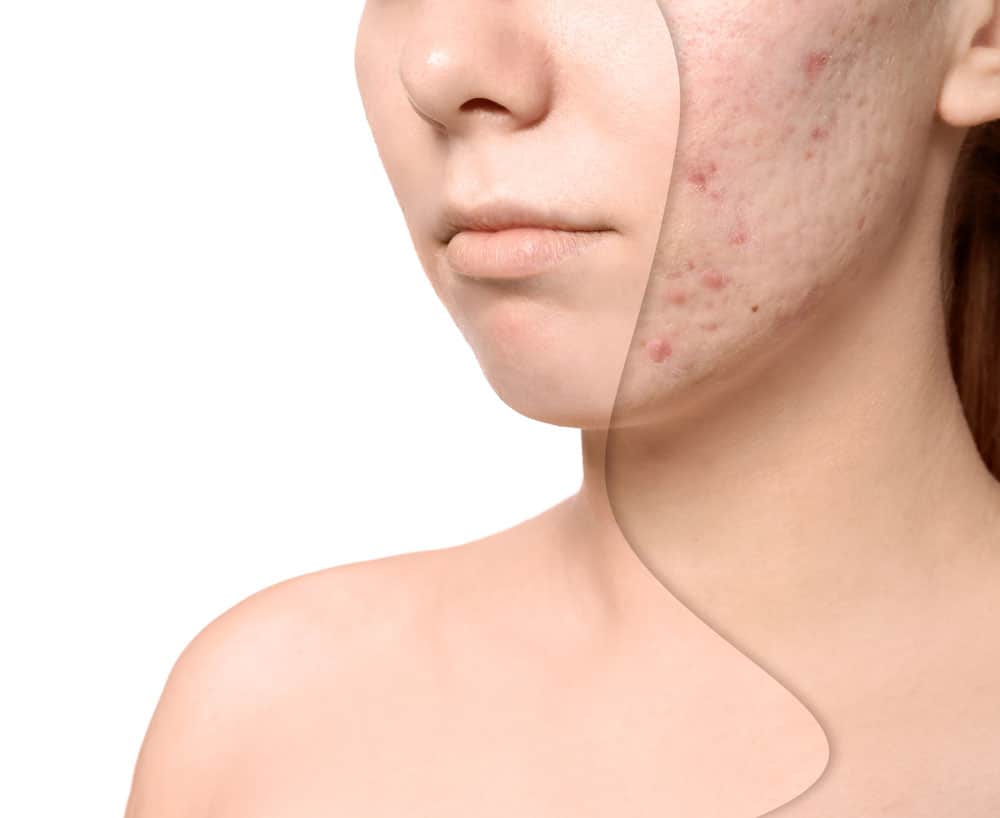
Atrophic scars
Atrophic scars are small indentations in the skin which occur when the skin does not produce sufficient fibroblasts during the healing process. Fibroblasts are cells that play a crucial role in wound healing and the synthesis of collagen. Atrophic scars are usually the results after acne, chicken pox, and indented scars. The indentation can form into one of three types or a combination of the following acne scars:

#1 Ice Pick Scars
This type of scar extends into the dermis and looks as if it was pierced by an ice pick. Some ice pick scars may resemble enlarged pores but are in fact small, thin, deep holes in the skin. The ice pick scar is the result of an infection caused by a cyst or another deep inflamed blemish that makes its way to the surface. Long, column-like scars are left behind due to the destruction of skin tissue.

#2 Boxcar Scars
A boxcar scar is a round or oval depression that has steep vertical sides, often resembling chicken pox scars. Unlike ice-pick scars, boxcar scars cause the skin to appear uneven and pitted. The skin over this area is left without support when collagen is destroyed by an inflammatory breakout. The extent of tissue loss can determine the severity of boxcar scars. It frequently occurs on the cheeks and temples, and have a rather wide cross-section measuring between 1.5 to 4mm in diameter.

#3 Rolling Scars
This type of scarring causes rolling or wave-like depressions across the surface of the skin. The formation of rolling scars is caused by fibrous bands of tissue developing between the skin and the subcutaneous tissue beneath. As these bands pull the epidermis down from within, they bind it to deeper structures of the skin, creating the rolling appearance.
Treating Acne Scars
Scarring after acne occurs frequently. It is an unwanted reminder of a painful and bothersome condition. When left alone, as you grow older, they will turn into more obvious and severe acne scars. However, acne scars do not have to be permanent, as recent advances in laser and ablative radiofrequency technology have allowed us to offer effective treatments in minimizing unsightly scar damage to the skin after acne.
Acne Scars Treatment with Today's Medical Technology - Dr Kenneth Thean
Topical scar removal creams may help but medical grade treatments are generally more effective in treating pitted scars. There are several types of treatment that can help reduce acne scars and improve the overall skin quality:
Ablative Laser Treatment
Laser treatment helps to lighten acne scars as it shedding away the top layer of the skin. Some of the common lasers used for acne scarring are Erbium YAG (Er:YAG) lasers, fractional carbon dioxide (CO2) lasers and other resurfacing lasers which can also reduce the pores and aid in skin renewal to reveal a healthier skin. However, it is not suitable for patients who are still suffering from acne breakouts or has darker skin tone of Fitzpatrick skin phototypes IV-VI. Asian skin in particular may develop a higher rate of (80%) post-inflammatory hyperpigmentation (PIH) in ablative laser treatment as compared to non-ablative fractional resurfacing.Non-Ablative Lasers
Non-ablative lasers such as picosecond lasers help to stimulate new and healthier collagen production which encourage new cell growth to replace damaged, scarred tissue. This treatment not only helps to smoothen acne scarring, it can also help to reduce the appearance of enlarged pores and treat post-acne marks or what is known as post-inflammatory hyperpigmentation.Medical Peels
Medical / Chemical Peels can also help to improve the appearance of acne scars by using chemical solution to remove the outer layer of the skin. However, this would require strong acids such as TCA or phenol peels to help reduce deep acne scarring. This type of strong acid is only suitable for fair-skin individuals and are usually not recommended for darker skin tone of Fitzpatrick skin prototypes IV-VI. As stronger chemical peels may cause depigmentation or stimulate post-inflammatory hyperpigmentation (PIH) which may results in an uneven skin tone.Dermal Filler
Dermal filler is one of the ways on how to reduce the appearance of acne scars. Although fillers can help to plump the skin and "fill up" the out depressed scars and even out skin tone, it is usually a temporary solution and may require to be injected every few months to maintain the results.Puro Treatment for Acne Scars
Puro is a customisable FDA cleared solution for acne scars that uses 160 micro pins to safely deliver heat via NanoFractional RF™ through the skin’s surface. The pins create tiny micro-dermal channels in the skin while conveying heat to the deeper layers of the skin, which then trigger the skin's natural wound healing response. This process stimulates collagen production to increase cellular turnover and improve skin barrier's resilience to treat skin damage, brighten the skin, reduce hyperpigmentation, lighten the appearance of acne scars and minimize the pores. This treatment is suitable for all skin types and has a much lower risk of PIH especially for darker skin tones. Additionally, this treatment is more comfortable than ablative lasers and results in smoother, healthier skin with minimal downtime.Intensif RF Microneedling Treatment for Acne Scars
This therapy is good for depressed scars that lie more than 1.5mm deep below the skin, microneedling helps. It is a procedure that uses a small, handheld, needle-studded roller containing to puncture the top layer of the skin. This encourages peeling which triggers the production of collagen and elastin during the recovery process, leaving the skin with a smoother and more even appearance. Results can be seen within 6 to 12 weeks after treatment. This treatment is popular because it provides effective results, carries lower risk of side effects, involves minimal downtime, and is suitable for darker skin tones.Dual Wave RF Microneedling Treatment for Acne Scars
This dual wave RF microneedling treatment uses continuous wave (CW) and pulsed wave (PW) modes of radiofrequency (RF) energy delivery. The continuous wave mode penetrates the skin more deeply , delivering heat energy into the skin's dermal layer and stimulating collagen and elastin production which helps to remodel and rejuvenate the skin as well as reduce the appearance of acne scars and improving texture. The pulsed wave RF energy delivers energy in intervals or pulses to help repair and strengthen the cell membrane - an important layer of cells that protect the skin from damage and help to regulate the exchange of nutrients and waste.
Ultimately, the effective treatment for acne scars will depend on the individual's skin type, severity of scarring, and desired results. It's important to consult with a qualified doctor, dermatologist or medical aesthetician to determine which treatment is suitable for you.
Acne Scar Removal in Singapore – Why We Don’t Use CO2 Lasers
In the past, fractional CO2 fractional lasers was commonly used to improve acne scars and uneven skin texture. The treatment works by creating controlled microscopic areas of injury in the skin, stimulating skin renewal and collagen remodelling.
However, when treating Asian and darker skin types, greater care is needed with aggressive ablative resurfacing. Higher treatment intensities can increase the risk of post-inflammatory hyperpigmentation (PIH), prolonged redness and longer downtime, particularly when trying to treat deeper acne scars.
Another limitation is that not all acne scars are primarily a surface problem. Deeper depressed scars often involve structural changes beneath the skin, so simply increasing the intensity of surface resurfacing may not necessarily produce better results — and may instead increase downtime and the risk of pigmentation.
For this reason, Dr Kenneth Thean, Dr Chiam Chiak Teng and Dr Daniel Toh take a more targeted approach to acne scar treatment in Singapore. Depending on the type, depth and severity of the scars, treatment may involve fractional Erbrium Yag lasers resurfacing, radiofrequency microneedling and other targeted scar treatments. Rather than relying on a single aggressive resurfacing treatment, the aim is to match the treatment and treatment depth to the type of acne scar while taking the patient’s skin type and risk of pigmentation into consideration.
With newer technologies, acne scars can now be treated at different depths within the skin, rather than focusing only on surface resurfacing.
For deeper scars, fractional ablative treatment can reach depths of up to 500 microns, helping to remodel scarred tissue beneath the surface. Treatments that deliver energy deeper into the dermis can also stimulate collagen production and remodelling, gradually improving the support and structure of the skin.
This allows acne scar treatment to work at multiple levels — resurfacing uneven texture, remodelling deeper scar tissue and rebuilding collagen — to gradually soften depressed scars and create a smoother, more even skin surface.
Other treatments, such as chemical peels, may also be incorporated for selected patients to improve superficial scarring, pigmentation and overall skin texture.
Improvement may be seen after a single treatment, although deeper or more established acne scars typically require a series of treatments. By selecting the appropriate technology, depth and treatment intensity according to the scar and skin type, treatment can be performed progressively while managing downtime and the risk of complications.