




Forehead Lines Treatment in Singapore
Forehead lines, sometimes called worry lines, are horizontal wrinkles that develop across the forehead. They commonly appear when you raise your eyebrows or make facial expressions.
The frontalis muscle raises the eyebrows. Every time this muscle contracts, it folds the overlying skin and creates horizontal forehead lines. At first, these lines may only appear during facial movement. Over time, repeated muscle activity combined with changes in collagen, elastin and skin elasticity can cause the lines to become deeper and remain visible even when the forehead is relaxed.
What Causes Forehead Lines?
Repeated facial expressions play an important role in the development of forehead wrinkles, but they are not the only contributing factor. Several factors can make forehead lines more noticeable:
Repeated raising of the eyebrows and facial expressions
Natural frontalis muscle activity
Age-related loss of collagen and elastin
Reduced skin elasticity
Sun exposure and photoageing
Individual facial anatomy and muscle strength
Genetics and lifestyle factors
Forehead lines can generally be classified as dynamic or static wrinkles. Understanding the difference helps determine the appropriate treatment approach.
From Facial Expressions to Deep Wrinkles

Dynamic Forehead Lines
Dynamic forehead lines appear mainly when you raise your eyebrows or make facial expressions. The frontalis muscle contracts and repeatedly folds the skin across the forehead.
When you relax your forehead, these lines may disappear or become much less noticeable.
Because muscle activity primarily drives dynamic forehead wrinkles, treatments that temporarily reduce excessive muscle contraction may help soften their appearance.
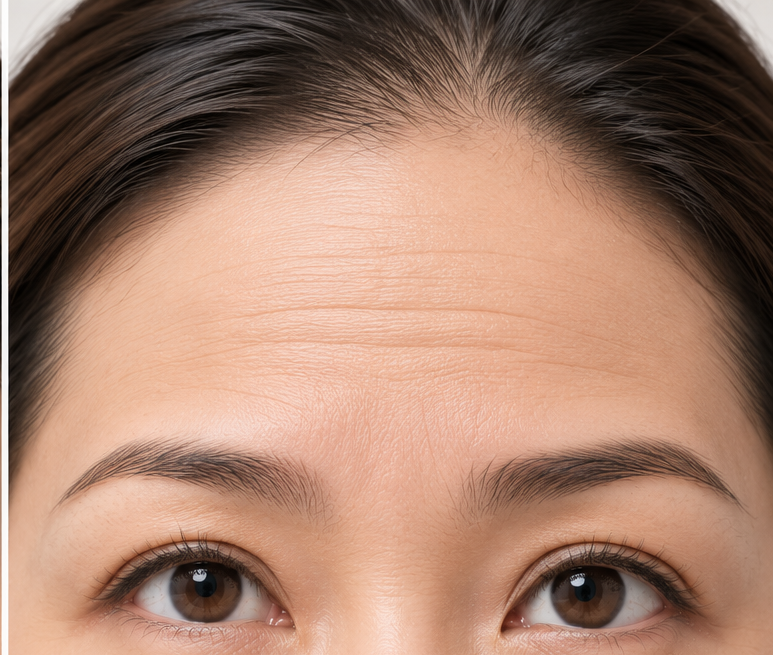
Static Forehead Lines
Over time, repeated folding of the skin combined with age-related changes in collagen, elastin and skin elasticity can cause forehead lines to become more established.When forehead lines remain visible even when the forehead is relaxed, they are known as static wrinkles.
At this stage, muscle activity may no longer be the only contributing factor. Changes in skin quality, collagen support, elasticity, volume and skin texture may also influence the depth and appearance of the lines.
For this reason, established static forehead lines may require a different or combination treatment approach rather than treatment of muscle activity alone.
Treating Forehead Lines with Neurotoxin Injections
For dynamic forehead lines, neurotoxin injections may temporarily reduce the activity of selected areas of the frontalis muscle.
By reducing excessive muscle contraction, treatment limits repeated folding of the skin and can help soften horizontal forehead lines while maintaining natural facial expression.
The frontalis muscle also plays an important role in raising and positioning the eyebrows. The doctor therefore needs to assess the individual's eyebrow position, muscle strength, facial anatomy and wrinkle pattern when determining the appropriate injection points and dosage.
The effects are temporary and gradually decrease as muscle activity returns. The duration of results varies between individuals and commonly lasts for several months.
Treating Static Forehead Lines
When forehead lines remain visible while the face is relaxed, reducing muscle activity alone may not fully address their appearance.
Depending on what contributes to the lines, treatment may also focus on skin quality, collagen, elasticity, texture or structural support.
Selected cases may benefit from treatments such as laser or energy-based treatments, resurfacing treatments, injectable treatments or dermal fillers, depending on the underlying cause and individual facial anatomy.
Rather than assuming that every deep forehead crease requires a filler, a doctor should first assess what is contributing to the static line and determine the appropriate treatment approach.
What Other Areas Can Neurotoxin Injections Treat?
In addition to horizontal forehead lines, neurotoxin injections may be used for selected facial lines and concerns associated with muscle activity.
Common treatment areas include:
- Frown lines between the eyebrows
- Horizontal forehead lines
- Nose wrinkles or bunny lines
- Crow's feet around the outer corners of the eyes
- Selected brow areas
- Chin dimpling or wrinkles
The treatment area, dosage and injection points vary according to the individual's facial anatomy, muscle activity and treatment goals.
Dynamic wrinkles are only present with facial expressions and can be easily reversed by neurotoxin injection. As your overlying skin becomes damaged and these muscles get stronger, your wrinkles will mature into static skin creases, which are permanently present. It is impossible to smooth out permanent wrinkles with only neurotoxin injection. This is because dermal fillers are necessary to plump up creases with fat loss. It is therefore not a good idea to wait until lines become fixed into the skin, as it is much more difficult to rectify.
Safety of Neurotoxin on Forehead Lines
The US Food and Drug Administration (FDA) has approved specific botulinum toxin products for the temporary improvement of moderate to severe forehead lines in adults.
Treatment usually involves a series of small injections into selected areas of the forehead and typically requires minimal recovery time. Some people may experience temporary effects such as redness, swelling, bruising, tenderness or headache around the treatment area.
Careful assessment and injection placement are particularly important when treating the forehead because the frontalis muscle influences both forehead movement and eyebrow position.
The effects of neurotoxin injections are temporar'y and gradually wear off as muscle activity returns. Results commonly last for several months, although the exact duration varies between individuals.
A medical assessment can determine whether neurotoxin treatment is suitable based on the individual's facial anatomy, muscle activity, medical history and treatment goals.